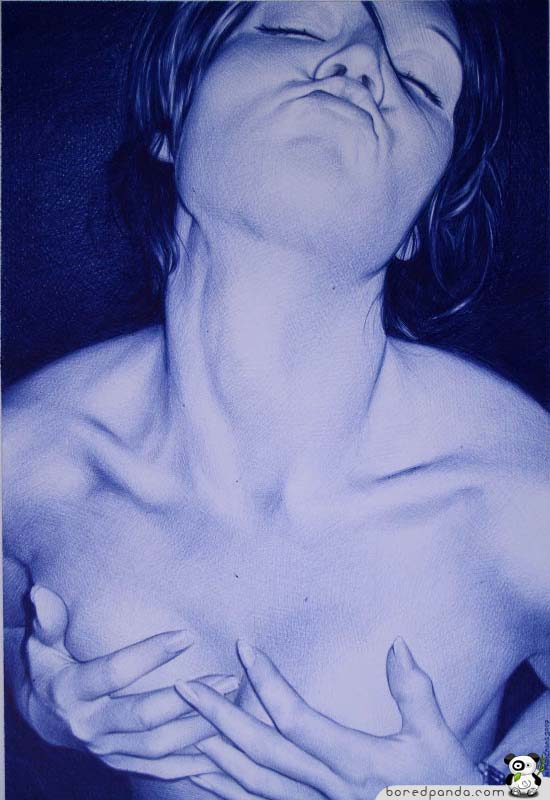
New photorealist/hyperrealist artists added 2010.

I have added some more of my favourite photorealist and hyperrealist artists to my ever growing list posted in November 2009:
THE BEST PHOTOREALISTS/HYPERREALISTS LIST

I have added the following artists so far this year:
Juan Francisco Casas - figurative artist that mainly uses biro.


Sam Jinks - sculptor, often quite disturbing works.


Evan Penny - sculptor, famous for producing distorted figure sculptures.


Cesar Santander - artist often depicting antique tins and toys.


Josep & Pere Santilari - two twin Catalonian brothers that paint figures and still life.


Jamie Salmon & Jackie K. Seo - sculptors of hyperreal figures.


Cynthia Westwood - figurative artist often depicting the female nude bathing.


As and when I come across more, I will update the list. Any suggestions as to artists that I could add are very welcome.

Feel free to add a link to the list if you like too: http://designmobius.blogspot.com/2009/11/hyperrealistsphotorealists.html"


Comments

  1. Ron Mueck is at the top of the heap in my book. Don Eddy is now posting his new work and studio pix on facebook. I have been following his work for 25 years and it just gets better.

    ReplyDelete

Post a Comment

Popular posts from this blog

The Impact of AI on the Art World: A Double-Edged Sword

Art, in its many forms, has been a cornerstone of human culture for millennia. From the cave paintings of our ancestors to the digital art of today, it has always been a medium for expression, communication, and reflection. However, the advent of Artificial Intelligence (AI) has brought about a seismic shift in the art world, particularly in the realms of realism and photorealism. While AI has the potential to revolutionize these art movements, it also poses significant challenges and threats.  ## The Rise of AI in Art AI's involvement in art is not a new phenomenon. In fact, it has been gradually infiltrating the art world for several years now. AI algorithms can now generate artwork, and some of these pieces have even been sold at prestigious auction houses.  (images created at random using Midjourney) However, the impact of AI on art is not limited to the creation of new pieces. It also extends to the way we interact with and interpret art. For instance, AI can anal...

The Art of the Intimate Scale | Chapter 1 of 12: What is Miniature Painting?

  The Art of the Intimate Scale Chapter 1: What is Miniature Painting? Definitions, Scale, the RMS Canon & Why the Word Has Nothing to Do With Small Chapter 1 of 12 The word "miniature" has deceived the world for five centuries. It does not mean small. Understanding this single etymological fact is the foundation of everything that follows — and the single most powerful opening line you own as RMS President. The Etymology: Minium, Not Minor The term derives from the Latin miniare — to paint or illuminate with minium , the bright red lead pigment (lead tetroxide, Pb₃O₄) used by medieval scribes to draw the decorative initial letters and ornamental borders of manuscripts. The artisan who did this work was a miniator . The resulting decorated letter was a miniatura . The confusion with "small" arose from a happy accident: portrait miniatures were indeed tiny objects. By the time the word entered English usage in the 16th century, the two concepts had become fused ...

Photorealism vs. Hyperrealism: A Deep Dive into Two Remarkable Fine Art Movements

In the realm of fine art, the terms photorealism and hyperrealism are often used interchangeably. However, these two movements, while sharing similarities, are distinct in their approach to creating visually stunning and lifelike images. In this blog post, we will explore the differences between photorealism and hyperrealism, delving into their origins, techniques, and the artists who have made significant contributions to these movements. Photorealism: The Art of Mimicking Reality Photorealism emerged as an art movement in the late 1960s and early 1970s in the United States. It was a response to the abstract expressionist movement, which dominated the art world at the time. Photorealist artists aimed to create paintings that were so detailed and accurate that they could be mistaken for photographs. This required incredible skill and patience, as artists would closely study their photographic references and meticulously reproduce them on canvas. Some of the key ...